
Decoding the Pareto Front: The Trade-off Map
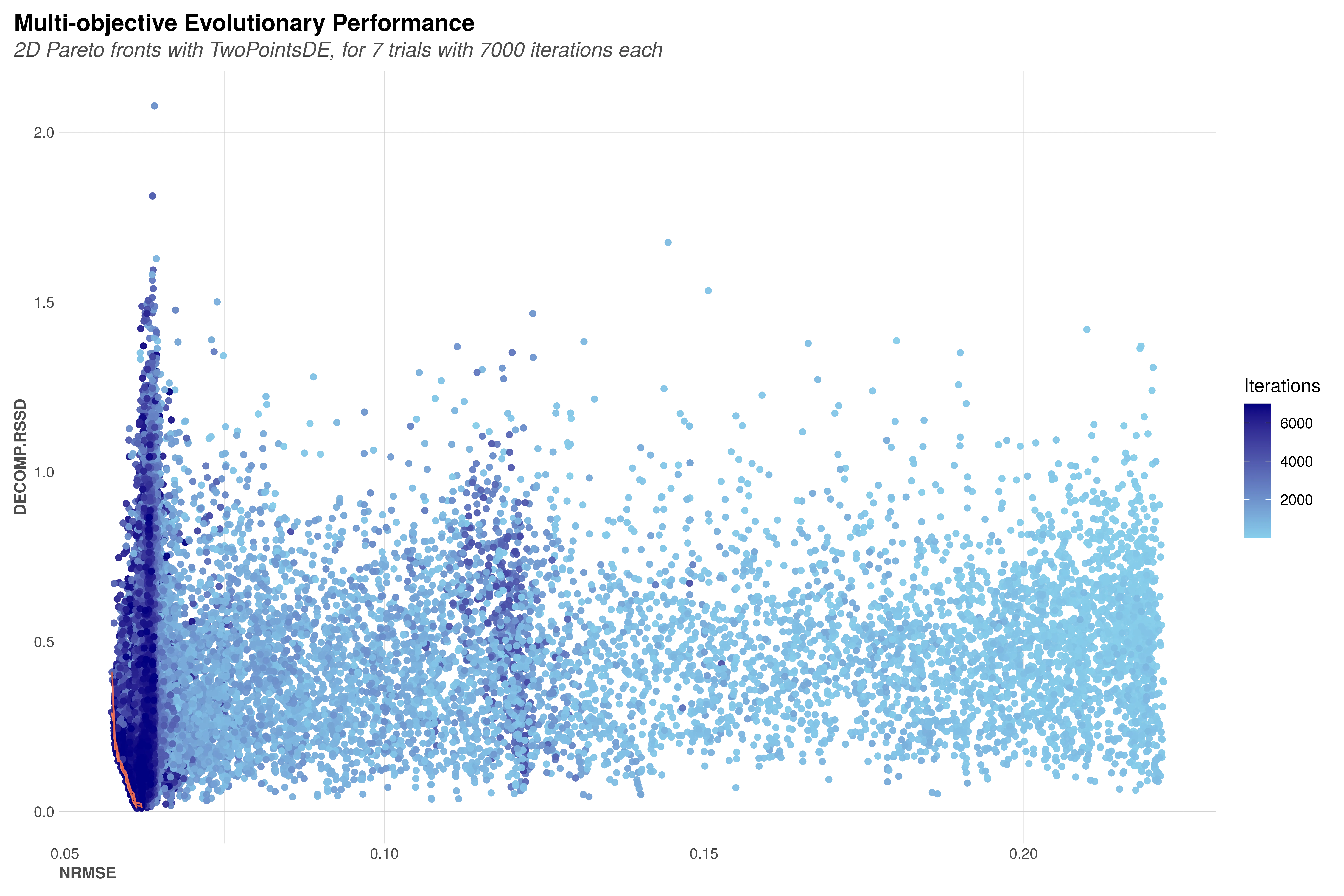
Why am I seeing this? You have just completed a modeling run. MMM Pilot didn’t just build one model; it built thousands. It then discarded the junk and kept only the “efficient” ones.
This chart is your Menu of Options. It displays the surviving models that represent the best mathematical compromises between two competing goals: Accuracy and Logic.
1. The View: What You’re Looking At
Each dot on this chart is a distinct, fully functional marketing model. They are plotted against two critical axes:
- NRMSE (Model Fit / Accuracy):
- What it is: “Normalized Root Mean Square Error.” It measures how closely the model’s predictions match your actual historical sales.
- Goal: Lower is better. A low NRMSE means the purple prediction line tracks your actual yellow sales line very closely.
- DECOMP.RSSD (Business Logic / Stability):
- What it is: “Decomposition Root Sum of Squared Distance.” This measures the disconnect between what you spent and what the model says you got.
- The Logic: If you spent 50% of your budget on Facebook, but the model says Facebook only drove 1% of your sales, that is a high RSSD (a large “distance” between spend and effect).
- Goal: Lower is better. A low RSSD means the model attributes impact roughly in proportion to your spend levels.
2. The Insight: The “Curve” of Compromise
You will notice the dots form a curve (the “Front”) moving from top-left to bottom-right. This curve represents a fundamental trade-off. You rarely get a model that is perfect at both.
- The “Math Whiz” (Low NRMSE, High RSSD):
- These models fit the wiggly lines of your sales chart perfectly. However, they often attribute sales to channels in ways that defy business sense (e.g., claiming a tiny newsletter caused a massive sales spike just because they happened on the same day).
- The “Safe Bet” (High NRMSE, Low RSSD):
- These models are very logical. They assume that if you spent money, it probably worked. However, they might fail to predict the peaks and troughs of your actual sales data because they are “smoothing” reality too much.
3. The Selection: How the Winner is Picked
You do not need to manually analyze every dot on this curve. The system automates the selection process in two distinct steps:
- Step 1: Robyn’s Shortlist (The Clusters) First, the underlying Robyn framework analyzes the entire “Pareto Front.” It identifies the most optimal models—typically the ones located at the “elbows” of the curve where the trade-off is balanced. It groups these into a small shortlist of top contenders (Clusters) that are already mathematically verified as “Best”.
- Step 2: AI Verdict (The Final Decision) MMM Pilot sends this elite shortlist to the AI Analysis Module. The AI does not recalculate the math; instead, it acts as a strategic judge. It reviews the business characteristics of these 5-10 finalists and selects the single “Best” Model ID that offers the most plausible narrative for your business.
4. Critical Warning: The “Perfect Fit” Trap
Do not obsess over finding the dot with the absolute lowest NRMSE (Fit).
The Risk: A model with 99% accuracy often suffers from Overfitting. It has “memorized” the noise in your data. If you use this model to forecast next month’s sales, it will likely fail because it is too rigid.
Navigator’s Rule: It is often better to choose a model with slightly higher error (higher NRMSE) if it offers significantly better business logic (lower RSSD). A model that makes sense is actionable; a model that is merely a “perfect line” is often a mirage.